|
After a patent is granted in Korea, a patentee must pay the applicable registration fee and annuities to the Ministry of Intellectual Property (MOIP) to keep the patent in force. If an annuity is not paid by the applicable deadline, the patent will lapse. However, Korean patent law provides a mechanism for restoring a patent that has lapsed in certain circumstances. On August 20, 2026, the Korean National Assembly passed an amendment to the Korean Patent Act concerning the restoration of rights, which will make it easier to restore certain lapsed Korean patents. This article provides an overview of this amendment.
1. Basic Principles of Restoring a Lapsed Patent
In accordance with Article 5bis of the Paris Convention, Korean patent law provides a six-month grace period (the "late-payment period") after the due date for paying the registration fee or an annuity. Restoration becomes relevant only after this late-payment period has expired. Allowing restoration to be requested without any time limit could prejudice bona fide third parties that have begun working the invention in reliance on the lapse of the patent. Accordingly, a restoration request must be filed within a prescribed period after expiration of the late-payment period.
2. Amendment to Article 81-3 of the Korean Patent Act (Restoration of Patent Applications and Patent Rights through Additional Payment or Supplementation of Patent Fees, etc.)
The recent amendment to the Korean Patent Act primarily affects Article 81-3, which governs the restoration of patent applications and patent rights through the additional payment or supplementation of patent fees. The table below compares the provision before and after the amendment. Before the amendment, Article 81-3(1) allowed restoration only where there was a "justifiable reason." The "justifiable reason" standard had been applied to circumstances such as sudden hospitalization due to COVID-19, hospitalization due to a pre-existing medical condition, or an error in an automatic fee-payment arrangement. According to statistics, domestic individuals and small and medium-sized enterprises (SMEs) accounted for as much as 83% of restoration requests filed on such grounds, while only about 16% of the requests were accepted as satisfying the "justifiable reason" requirement. This highlighted the need for greater protection of the rights of domestic individuals and SMEs. Under the amendment, restoration will generally be available unless the failure was intentional.
| NO |
Related Provision of the Korean Patent Act |
Before Amendment |
After Amendment |
| 1 |
Article 81-3(1) |
Where a person seeking registration of a patent right or a patentee fails to pay the patent fee within the additional payment period or to supplement the fee within the supplementation period for a justifiable reason, the person may pay the patent fee or supplement it within two months from the date on which the reason ceases to exist. However, this shall not apply if one year has elapsed from the later of the expiration date of the additional payment period or the expiration date of the supplementation period. |
Where a person seeking registration of a patent right or a patentee fails to pay the patent fee within the additional payment period or to supplement the fee within the supplementation period, for a justifiable reason,pay the patent fee or supplement it within two months from the date on which the reason ceases to exist. However, this shall not apply if one year has elapsed from the later of the expiration date of the additional payment period or the expiration date of the supplementation period. |
| 2 |
Article 81-3(2) |
A person who paid the patent fee or supplemented the patent fee under paragraph (1) shall be deemed, notwithstanding Article 81(3), not to have abandoned the patent application, and the patent right shall be deemed to have continued in force. |
A person who, under paragraph (1), paid the patent fee or supplemented the patent fee under paragraph (1) |
| 3 |
Article 81-3(3) |
Where a patent right has lapsed because the patent fee was not paid within the additional payment period or supplemented within the supplementation period, the patentee may, within three months after expiration of the additional payment period or supplementation period, pay twice the patent fee under Article 79 and request restoration of the lapsed right. In such a case, the patent right shall be deemed to have continued in force. |
Same as before amendment. |
| 4 |
Article 81-3(4) |
The effect of a patent application or patent right under paragraph (2) or (3) shall not extend to any act by another person of working the invention for which the patent application was filed or the patented invention during the period from the day after expiration of the additional payment period or supplementation period until the day on which the patent fee is paid or supplemented (hereinafter in this Article referred to as the "period of restricted effect"). |
ave continuThe effect of a patent application or patent right under paragraph (2) or (3) shall not extend to any act by another person of working the invention for which the patent application was filed or the patented invention during the period from the day after expiration of the additional payment period or supplementation period until the day on which the patent fee is paid or supplemented |
| 5 |
Article 81-3(7) |
Matters necessary for payment or supplementation under the main clause of paragraph (1) or for a request under the first sentence of paragraph (3) shall be prescribed by Prime Ministerial Decree. |
Matters necessary for payment or supplementation |
3. Methods for Restoring a Patent Right Under the Amended Korean Patent Act
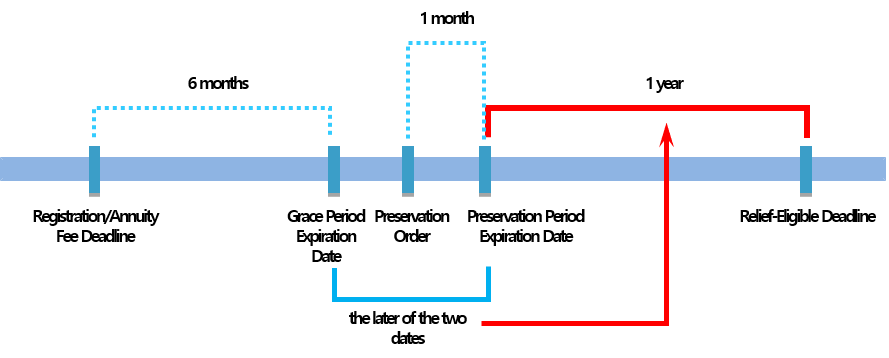
Article 81-3 provides two principal routes for restoring a patent right. Paragraph (1) requires that the failure to pay be unintentional, but provides a relatively long, one-year restoration period in exchange for payment of three times the patent fee. Paragraph (3), by contrast, does not require any particular reason for the failure, but only provides a three-month restoration period and requires payment of twice the patent fee. Although paragraph (3) imposes no requirement as to the reason for non-payment, it carries a lower fee multiplier. This difference can be understood in light of the substantially longer restoration period available under paragraph (1). The effective date of the amendment has not yet been set. Under the supplementary provisions, however, the amended provisions will apply to cases in which the additional payment period or supplementation period (i.e., the period for making up a deficiency in the patent fee) expires after the effective date.
| NO |
Related Provision of the Korean Patent Act |
Ground |
Fee Payable |
Illustrative Timeline (red portion indicates the restoration period) |
| 1 |
Article 81(3)(1) |
Unintentional |
3x the patent fee |
 |
| 2 |
Article 81(3)(3) |
None |
2x the patent fee |
.png)
or
.png)
|
4. The "Unintentional" Standard Under the Patent Law Treaty (PLT)
Under the PLT, the "unintentional" standard is generally used in petitions for restoration of rights. It refers to a situation in which the patentee did not intend to miss the relevant deadline, and it may include a simple mistake or error even where the patentee was aware of the applicable requirements. The burden of establishing that the failure was unintentional rests with the patentee. Since the "unintentional" standard generally needs to be reflected in domestic law upon accession to the PLT, the amendment may also be viewed as an initial procedural step toward Korea's possible future accession to the PLT.
|